Save Save Save
ISPP REMINDER
September 2006
Dear Friends & Colleagues,
In case you haven't noticed, it's just about that time of year once again. Time to start looking over the lesson plans, dust off the books and tune up the lecture demo's. The academic year is almost upon us. Time to start thinking again about new and interesting ways to get your students excited about physics. But what can you do? You need resources! You need ideas. Where can you find it all?? ISPP!!
Perhaps you already have the ideas. Perhaps you've attended a summer workshop. You're excited about it. What now? Share them with ISPP!!
OUR FIRST MEETING OF THE 2006 - 07 SEASON . . . OUR NEXT MEETING . . .
. . . is at New Trier High School
Thursday
September 14, 2006
6:30 - 9:00 p.m.
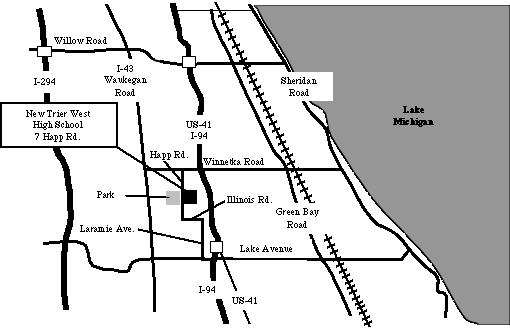
A map and directions are enclosed.
THE FREE GIVEAWAY . . .
. . . something you should find useful to excite student interest in physics - and who knows? - maybe even your own!
FUTURE MEETINGS. . .
September 14 (Thursday) New Trier High School) – Tom Senior
October 18 (Wednesday) Oak Park- River Forest High School – Kevin McCarron
October 13-14 (Fri – Sat) ISAAPT Rock Island HS
Oct/ Nov ? (Saturday) CSAAPT at New Trier High School – Nick Drozdoff/Tom Senior
December 5 (Tuesday) DePaul University - Gerry Lietz /John Milton
January 17 (Wednesday) Elmhurst College - Earl Swallow
AT OUR LAST MEETING . . .
 Ruth
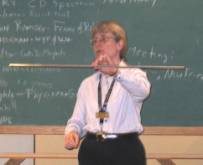
Goehman (Museum of
Science and Industry) greeted us and called the meeting to order by intoning a
pitch on an aluminum rod. Rather than use the traditional rosin she stroked
the rod with the sticky side of a piece of scotch tape while holding it in the
exact middle. Then she held it at the one-quarter mark and intoned the second
harmonic. Ruth had another example of resonance in the Chinese Spouting Bowl
(available from Educational Innovations (http://www.teachersource.com) @ $200).
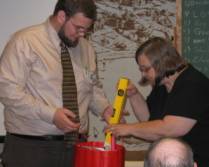
Lastly Ruth showed us a variation on the Cartesian diver. The diver was
fabricated from a plastic pipette. In a game version two divers are placed in
the bottle. A sinker diver is weighted to fall to the bottom. It has a wire
loop attached. The second hook diver can be raised or lowered by exerting
pressure on the fluid in the bottle. It also has a wire hook attached. The game
is to hook the sinker diver with the hook diver and raise the two together.
Details can be found in the Educational Innovations Catalog.
Ruth
Goehman (Museum of
Science and Industry) greeted us and called the meeting to order by intoning a
pitch on an aluminum rod. Rather than use the traditional rosin she stroked
the rod with the sticky side of a piece of scotch tape while holding it in the
exact middle. Then she held it at the one-quarter mark and intoned the second
harmonic. Ruth had another example of resonance in the Chinese Spouting Bowl
(available from Educational Innovations (http://www.teachersource.com) @ $200).
Lastly Ruth showed us a variation on the Cartesian diver. The diver was
fabricated from a plastic pipette. In a game version two divers are placed in
the bottle. A sinker diver is weighted to fall to the bottom. It has a wire
loop attached. The second hook diver can be raised or lowered by exerting
pressure on the fluid in the bottle. It also has a wire hook attached. The game
is to hook the sinker diver with the hook diver and raise the two together.
Details can be found in the Educational Innovations Catalog.
Dawnne LePretre (Museum of Science and Industry) introduced herself as the Manager of Public Programs and announced a number of openings in the museum staff, in particular, for a Demonstration Development Coordinator. This is an exciting position for someone who is enthusiastic to share science with the public. The Museum is involved a capital campaign to enliven the floor of the museum. Information can be obtained from the Museum web site http://www.msichicago.org/info/HR/employ_opps.html
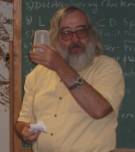 Gerry
Lietz (DePaul
University) reminded us about the next ISPP meeting September 14 at New Trier
High School. He asked if there were any new attendees. Mark Durante, student teacher from Hinsdale Central
High School raised his hand. Debbie Lojkutz
(Joliet Central High School) presented him with a New Teacher Bag. Gerry
encouraged young teachers to bring equipment to meetings that they may have
questions about. He also encouraged us to bring old demos even if we may have
seen it before because you just might have a new insight or wrinkle. Peter
Insley (Columbia
University) explained that the proper way to show the phenomenon is not to just
show the demonstration and explaining the physics behind it but rather show the
phenomena without explanation and let the students learn the physics by asking
questions.
Gerry
Lietz (DePaul
University) reminded us about the next ISPP meeting September 14 at New Trier
High School. He asked if there were any new attendees. Mark Durante, student teacher from Hinsdale Central
High School raised his hand. Debbie Lojkutz
(Joliet Central High School) presented him with a New Teacher Bag. Gerry
encouraged young teachers to bring equipment to meetings that they may have
questions about. He also encouraged us to bring old demos even if we may have
seen it before because you just might have a new insight or wrinkle. Peter
Insley (Columbia
University) explained that the proper way to show the phenomenon is not to just
show the demonstration and explaining the physics behind it but rather show the
phenomena without explanation and let the students learn the physics by asking
questions.
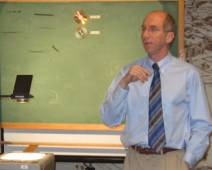
Paul Dolan (Northeastern Illinois University) encouraged us to attend Expos and trade shows in the Chicago area for the various freebies you can pick up. He placed a small disc on the overhead projector. He told us that it was a marker used by golfers to mark the position of the ball while another golfer plays through. This one was a freebie he picked up at Rosemont. He noted that this marker was made special for inexperienced golfers to give them an edge. The disc had a small circular notch in one side and a dimple on it that would deflect the ball of a more experienced person playing through.
 Paul
showed us another sound phenomenon. He held up a cup with a string attached to
bottom. The string passed through a hole in the bottom of the cup and was tied
to a paperclip to keep the string from slipping out of the hole. He pulled down
on the string with the wet napkin and produced a sound like a clucking chicken.
Paul
showed us another sound phenomenon. He held up a cup with a string attached to
bottom. The string passed through a hole in the bottom of the cup and was tied
to a paperclip to keep the string from slipping out of the hole. He pulled down
on the string with the wet napkin and produced a sound like a clucking chicken.
 Dave
Lowry (Hillcrest
High School) taped two disks to the board, one a CD and the other a DVD. He
illuminated them with the light from the overhead projector. When he presents
this to his class, his students see different colors of the spectrum depending
on where they sit in the class. He uses the tiles on the floor to determine
the angle locating the particular colors and from this the students calculate
the density of tracks. Normally he uses a slide projector that has a narrow
beam of white light that avoids some spurious spectra that we were noticing.
Dave noted that the DVD had more closely spaced tracks than the CD. Gerry Lietz
playfully noted that the spectrum does not contain all the colors, for example
silver, magenta or brown, etc.
Dave
Lowry (Hillcrest
High School) taped two disks to the board, one a CD and the other a DVD. He
illuminated them with the light from the overhead projector. When he presents
this to his class, his students see different colors of the spectrum depending
on where they sit in the class. He uses the tiles on the floor to determine
the angle locating the particular colors and from this the students calculate
the density of tracks. Normally he uses a slide projector that has a narrow
beam of white light that avoids some spurious spectra that we were noticing.
Dave noted that the DVD had more closely spaced tracks than the CD. Gerry Lietz
playfully noted that the spectrum does not contain all the colors, for example
silver, magenta or brown, etc.
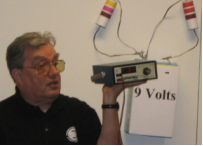
Roy Coleman (Morgan Park High School, retired) recalled the unofficial slogan of ISPP demo team from the summer AAPT meeting at Notre Dame in 1994 “Bigger is Better” showed us what he uses when he show his students electrical circuits in class. He got the idea from Eric Jurgens (Joliet West High School) to build extra large scale power supply and matching extra large scale resistors which he made by mounting regular sized resistors inside cardboard tubes. He painted the tubes with stripes to look like normal size resistances. Each of the large-scale components also contained a magnet that allowed them to stick to a magnetic black board.
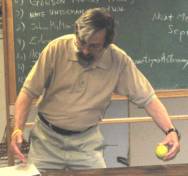
Gordon Ramsey (Loyola University) recalled for us that in an inertial reference frame the laws of physics will be the same as in any other inertial frame. Normally he would use a skateboard to give him a constant velocity frame of reference but it would not work on the carpet in the room. So instead, he walked at a constant speed while dropping the ball on a hard level surface (a book on the table). We saw the ball follow a parabolic path and could determine the acceleration to be g down. From his point of view Gordon described the motion to be in a vertical straight line but would also agree that the acceleration was g down.
Then Gordon let it roll along the surface of the table and collide with the spine of the book. It bounced back with nearly the same velocity but in the opposite direction. He described the change of momentum from our point of view as Dp = pf – pi = - mv – (mv) = - 2mv. Then he repeated the experiment while he was moving at the same speed as the ball and described the collision from his point of view. At first the ball was stationary in his frame and then after the collision the ball was moving in the opposite direction at twice the speed that we observed in our frame. He calculated that the change in momentum from his vantage Dp = pf’ – pi’ = - 2mv – 0 = - 2mv the same result we observed. He explained that since we see the same change of momentum we must agree on the forces involved. The laws of physics are the same in all proper frames of reference. Gordon repeated the process for the case of a perfectly inelastic collision where the ball ideally would have stuck to the book. Again he arrived at with the conclusion the change of momentum turns out the same no matter which frame you make the observations in.
 Nate Unterman (Glenbrook North High School)
reported on how he and his students had proposed experiments for the Weightless
Wonder, a DC9 (formerly the Vomit Comet was a KC135). Two of their experiments
were accepted and he was given the opportunity to fly with them. Six schools
were represented and people were invited to accompany the experiments.
Unfortunately the students could not go due to insurance concerns, but three
teachers did. They had to go through a special training. Nate showed us a
series of slides documenting his trip. An article about the flight should
appear in October issue of Sky and Telescope. Nate passed out a packet
describing details of the trip.
Nate Unterman (Glenbrook North High School)
reported on how he and his students had proposed experiments for the Weightless
Wonder, a DC9 (formerly the Vomit Comet was a KC135). Two of their experiments
were accepted and he was given the opportunity to fly with them. Six schools
were represented and people were invited to accompany the experiments.
Unfortunately the students could not go due to insurance concerns, but three
teachers did. They had to go through a special training. Nate showed us a
series of slides documenting his trip. An article about the flight should
appear in October issue of Sky and Telescope. Nate passed out a packet
describing details of the trip.
 One of
the experiments examined how fluids in the form of paint mixed in zero gravity.
They used a high-speed video camera to document the results. The main
experiment looked for electrostatic effects in 420-micron silicone dioxide
granules. Basically they were looking to see how the grains charged, whether
monopole dipole, etc. Fourteen people had to sign off on the experiment before
it could be loaded aboard the plane. He explained that within a few seconds of
becoming weightless you loose all perspective of what is up and down. So it was
good that they pointed out that the lights in the plane were near the ceiling
offering a good reference point.
One of
the experiments examined how fluids in the form of paint mixed in zero gravity.
They used a high-speed video camera to document the results. The main
experiment looked for electrostatic effects in 420-micron silicone dioxide
granules. Basically they were looking to see how the grains charged, whether
monopole dipole, etc. Fourteen people had to sign off on the experiment before
it could be loaded aboard the plane. He explained that within a few seconds of
becoming weightless you loose all perspective of what is up and down. So it was
good that they pointed out that the lights in the plane were near the ceiling
offering a good reference point.
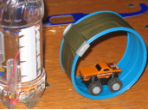
Incidentally, they brought along a Hydro GyroTM (available (where else?) from Educational Innovations @$10). This gyroscope has an inner clear capsule that contains colored water. Normally when the gyro is spun up the fluid surges to the outside of the capsule. In weightlessness the fluid did some strange things. Nate carried another toy on the mission, a car that rolled around on the inside of a circular hoop. Both toys had been shown at previous ISPP meetings. Nate passed out a page with relevant links for people to find out more about the project.
 John
Milton (DePaul
University) had a few more syringes from Janet Landato to give out. He
described how wanted to give his students experience plotting and analyzing data.
John had learned interestingly that the force of magnetism between the poles of
two magnets decreases as the fourth power of the distance between them. John
figured an easy way to obtain data for this example. He used two Pasco carts
each having magnetic bumpers to facilitate elastic collisions. He fixed one
cart to an inclined track and let the other cart rest against the first being
repelled by the magnet bumpers. He used the angle of the track to calculate the
component of gravitational force of the upper cart pushing down on the lower
one which then indicated the force of repulsion between the magnets.
John
Milton (DePaul
University) had a few more syringes from Janet Landato to give out. He
described how wanted to give his students experience plotting and analyzing data.
John had learned interestingly that the force of magnetism between the poles of
two magnets decreases as the fourth power of the distance between them. John
figured an easy way to obtain data for this example. He used two Pasco carts
each having magnetic bumpers to facilitate elastic collisions. He fixed one
cart to an inclined track and let the other cart rest against the first being
repelled by the magnet bumpers. He used the angle of the track to calculate the
component of gravitational force of the upper cart pushing down on the lower
one which then indicated the force of repulsion between the magnets.
John also has his students measure the inverse square relationship of the light intensity as a function of distance from the sources. John uses a Pasco light source as good point source. Some us also suggested the bare bulb from a MagliteTM flashlight or a #48 bulb from the Pasco CASTLE Kit. John measures the light intensity with a Pasco light sensor.
Another topic that John likes to bring up early on in the course is vectors. For this John passes out a map of the DePaul campus and asks his students to determine the distances from one building to another using various paths, as well as along the diagonal showing the commutative nature of vectors. John pointed out the convenience of being in Chicago where east-west blocks are very nearly 100 m and north-south blocks are close to 200 m. Doing the exercise with familiar land marks, John explained, brings the point literally home.
Eileen Wild (Retired) had a friend who teaches a driver education
course to people who have acquired quite a few speeding tickets, and when she
discusses collisions she uses model cars on a blanket on which she has drawn an
intersection. This inspired Eileen to think about using a similar set up to
discuss collisions in class. She place a transparency on the overhead projector
on which she had drawn an intersection of two roads. She then placed two
matchbox cars on the projector stage whose silhouettes could be seen in the
intersection. She rolled the one car up one street into the intersection where
it collided with  the other
and we could easily see how it resulted in a change of direction of motion of
both cars. Eileen had bought the cars at a local Jewel store that had a whole collection
of different cars. She strongly recommended the racecars because their wheels
could clearly be seen in silhouettes and it was clear that they where cars.
the other
and we could easily see how it resulted in a change of direction of motion of
both cars. Eileen had bought the cars at a local Jewel store that had a whole collection
of different cars. She strongly recommended the racecars because their wheels
could clearly be seen in silhouettes and it was clear that they where cars.
Then Eileen showed us an amusing ad she found in a Popular Science magazine in which the problem of tipping a cow was analyzed using forces and torques due to gravity and prankster tipper. Supposedly one person could tip the cow. Ultimately they calculate it would take four people pushing has hard as possible horizontally against the side of the cow.
Art Schmidt (Northwestern University) brought a pair of eyeglasses that happened to be his giveaway at the May meeting at Northwestern. When scene composed of a spectrum of colors is viewed through these glasses the red colors are shifted more to the center of the picture than the blues. As a result ones eyes are tricked into thinking that the scene has depth where the red colored objects are closer and blue colored objects appear further away. Pete Insley (Columbia University) the author of the Reminder for that meeting had wondered how these glasses worked. Art had few extra sets from the meeting and brought them to this meeting for us to ponder the physics involved.
 The clear
material that mad up the “lenses” resembled the holographic gratings commonly
used to view spectra. Pete volunteered his red laser pointer to show the
interference pattern produced by shining the laser beam through the material.
Fist he shown the laser on the wall directly and then aimed it through the
glasses. We saw how the principle maximum of the pattern was shifted to the
left with one lens and to the right with the other lens. We pondered how the
grating material was able to shift intensity the pattern away from the central
peak. We were reminded that a blazed grating would produce this effect by
shifting the maximum intensity from the m=0 order peak to one if the higher
order peaks on one side or the other. A blazed grating is one in which the
“profile” of the grating grove is a saw tooth rather than flat for ruled gratings
or sinusoidal for normal holographic gratings. These gratings are usually
optimized for a particular wavelength of light. By having the gratings for each
eye reversed from the other red colored things will be turned inward and appear
closer to the viewer than purple colored things whose light will be unaffected.
A web page was printed on the glasses to get more information and to download
images designed to be viewed through them. http://www.chromatek.com
The clear
material that mad up the “lenses” resembled the holographic gratings commonly
used to view spectra. Pete volunteered his red laser pointer to show the
interference pattern produced by shining the laser beam through the material.
Fist he shown the laser on the wall directly and then aimed it through the
glasses. We saw how the principle maximum of the pattern was shifted to the
left with one lens and to the right with the other lens. We pondered how the
grating material was able to shift intensity the pattern away from the central
peak. We were reminded that a blazed grating would produce this effect by
shifting the maximum intensity from the m=0 order peak to one if the higher
order peaks on one side or the other. A blazed grating is one in which the
“profile” of the grating grove is a saw tooth rather than flat for ruled gratings
or sinusoidal for normal holographic gratings. These gratings are usually
optimized for a particular wavelength of light. By having the gratings for each
eye reversed from the other red colored things will be turned inward and appear
closer to the viewer than purple colored things whose light will be unaffected.
A web page was printed on the glasses to get more information and to download
images designed to be viewed through them. http://www.chromatek.com
Art explained that he often uses bubbles to demonstrated thin film interference but lamented that the bubbles broke too quickly. He found a product in Educational Innovations that formed more durable bubbles. Unfortunately, these bubbles do not exhibit the thin film interference. In order to be robust the walls of the bubble were thicker than bubbles made with the traditional soap solution. Art related his experience with trying to blow bubbles with the solution for which the bubbles, according to the instructions, needed time to dry before they could be handled without breaking. Art blew the bubbles using Helium gas to float them so the didn’t drop to the floor and break. Instead he ended up with clusters of bubbles stuck to the ceiling of his demo room.
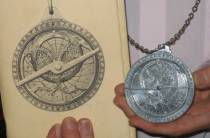 John
Dykla (Loyola
University) recalling the date for this meeting 6/6/06 of mystical
significance, showed us his Astrolabe an instrument used by ancient astronomers
to calculate the position of the planets and stars. He held up a pewter
instrument which he explained was a modern day copy which he bought 29 years
ago. John explained that the instrument was effectively a circular slide rule.
The backside had a sighting device. His came with a 67-page booklet “A Treatise
on the Astrolabe”, translated from Old English by R.T. Gunter in 1931 and later
revised by Norman Greene in 1977, was originally written by Sir Geoffrey
Chaucer of “Canterbury Tales” fame. He wrote it for his son Lewis who was age
10. He wondered if an English professor today would make such an effort to have
his 10-year-old son master aspects of geometry and science. The replica
Astrolabe (Pewter) is available from Greene Designs, P.O. Box 8451, Emeryville,
CA 94662
John
Dykla (Loyola
University) recalling the date for this meeting 6/6/06 of mystical
significance, showed us his Astrolabe an instrument used by ancient astronomers
to calculate the position of the planets and stars. He held up a pewter
instrument which he explained was a modern day copy which he bought 29 years
ago. John explained that the instrument was effectively a circular slide rule.
The backside had a sighting device. His came with a 67-page booklet “A Treatise
on the Astrolabe”, translated from Old English by R.T. Gunter in 1931 and later
revised by Norman Greene in 1977, was originally written by Sir Geoffrey
Chaucer of “Canterbury Tales” fame. He wrote it for his son Lewis who was age
10. He wondered if an English professor today would make such an effort to have
his 10-year-old son master aspects of geometry and science. The replica
Astrolabe (Pewter) is available from Greene Designs, P.O. Box 8451, Emeryville,
CA 94662
Dan Cahill (Grayslake Central High School) showed us a can of “Tab” which apparently has been reborn as an energy drink with the new but rather contradictory catch phrase “lo calorie energy drink”. Someone joked that it must contained dark energy? A college suggested that what is in it makes you feel energetic? Dan read the contents information: Sucrolose (possibly the artificial sweetener), 785 mg of taurne, 116 mg gin sing extract, etc. chemicals to make you feel and 5.0 calories At $2.25 a can that amounts to 45 cents per calorie.
 Tom
Senior (New Trier
High School) held up a Ziploc sandwich bag filled with some small Styrofoam
pellets. He brought a piece of charged plastic that he had charged by rubbing
the plastic PVC with paper to produce a negative charge on the plastic. The
balls squirmed around in the bag being repelled by the charged plastic and
themselves. Tom produced another bag with Styrofoam balls only these seemed to
be attracted to the piece of charged plastic. Tom used a piece of acrylic
plastic rubbed with paper to charge the plastic positively. Now the balls were attracted
to the plastic. He got a 2-liter package of Styrofoam balls from Educational
Innovations for $10. He suggested perhaps a store selling in beanbag chairs
might be a great source of Styrofoam balls. He showed us how he separated the
different charges. He dipped the negative charged plastic into a package of
balls, and drew out a bunch of positively charged balls that had been attracted
to the plastic. He then swept them off into a Ziploc bag. To get a package of
negatively charged balls he used the acrylic plastic dipped into the package.
Tom said that the balls retained their charge for a long time (two months)
since the Ziploc bag is a good insulator. The electric field does pass through
the bag but then you can’t charge the pellets inside the bag. Tom passed out a
sheet with details.
Tom
Senior (New Trier
High School) held up a Ziploc sandwich bag filled with some small Styrofoam
pellets. He brought a piece of charged plastic that he had charged by rubbing
the plastic PVC with paper to produce a negative charge on the plastic. The
balls squirmed around in the bag being repelled by the charged plastic and
themselves. Tom produced another bag with Styrofoam balls only these seemed to
be attracted to the piece of charged plastic. Tom used a piece of acrylic
plastic rubbed with paper to charge the plastic positively. Now the balls were attracted
to the plastic. He got a 2-liter package of Styrofoam balls from Educational
Innovations for $10. He suggested perhaps a store selling in beanbag chairs
might be a great source of Styrofoam balls. He showed us how he separated the
different charges. He dipped the negative charged plastic into a package of
balls, and drew out a bunch of positively charged balls that had been attracted
to the plastic. He then swept them off into a Ziploc bag. To get a package of
negatively charged balls he used the acrylic plastic dipped into the package.
Tom said that the balls retained their charge for a long time (two months)
since the Ziploc bag is a good insulator. The electric field does pass through
the bag but then you can’t charge the pellets inside the bag. Tom passed out a
sheet with details.
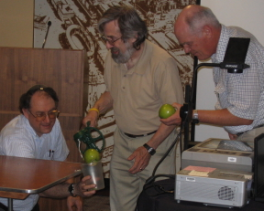
Then it was time for the annual John Rush Award. Bill Blunk (Niles West High School) explained the history of the award. The John Rush award is given to one of our members for exciting ideas and 'phun' contributions to the group. John taught for many years at Eisenhower High School in Blue Island, and coined the word 'pneumenon', a new phenomena that you haven't experienced. On the first day of class John would show his students a strange contraption and challenged them to discover what it was. Then Nate Unterman (Glenbrook North High School) announced this year's winner. Gordon Ramsey (Loyal University) came up to receive the award and clamped the 'pneumenon' to the table to peel the traditional apple.
Submitted by Arthur Schmidt
For any information regarding ISPP contact Gerry Lietz at DePaul University, Physics Department, 2219 N. Kenmore Chi. IL 60614 phone: 773-325-7333 e-mail glietz@depaul.edu. ISPP home page: http://condor.depaul.edu/~glietz/ispp/ispp.html
BRING FRIENDS BRING IDEAS ! ! SEE YOU THERE ! ! !
Tom Senior Art Schmidt Ann Brandon
Kevin McCarron Pete Insley Paul Dolan/Joe Hemanek
Gerry Lietz/John Milton Ruth Goehmann Mike Kash
Earl Swallow Debbie Lojkutz/Erik Jergns Van Bistrow/ Dennis Gordon
Gordon Ramsey Roy Coleman
Pete Insley Earl Zwicker
. . . . . . . . . . . . . . . . . . . . . . . . . . . . . . . . . . . . . . . . . . . . . . . . . . . . . . . . . . . . . . . . . . . . . . .
During 2006 - 07
Coordinators: Paul Dolan
Gerry Lietz
Earl Zwicker
ISPP Authors: Gerry Lietz Data Base Managers: Roy Coleman
Art Schmidt Earl Zwicker
John Milton
Pete Insley
Photographers: Paul Dolan Treasurers: Ann Brandon
Art Schmidt Peter Insley
Gerry Lietz
John Milton
Earl Zwicker
Special Events Committee:
Physics Day - Ann Brandon, Roy Coleman, (Co-Chairs)
John Rush Award - Gordon Ramsey, Nate Unterman, Eileen Wild (chair), Bill Blunk (ex-officio)
Harald Jensen Award - Keith Bellof (chair), Martha Lietz, Ann Brandon
Annual Tri - Physics Meeting - Bruce Illingworth, Gerry Lietz
National Bridge Building Committee - Carlo Segre
New Member Committee – Kevin McCarron (coordinator), Ann Brandon, Pete Insley, John Milton
FROM THE NORTH: Take I-94. Skokie Rd, US 41 S exit, to Lake Ave., West on Lake Ave. to Laramie Ave. (first left after crossing the expressway), North on Laramie to Illinois (dead end), West on Illinois Rd. to Happ Rd.(dead end – right turn only, just follow the black top), North on Happ Rd.to NTHS Campus.
Or Take Waukegan Rd. to Winnetka Rd., East on Winnetka Rd. to Happ Rd., South on Happ Rd. to NTHS Campus.
FROM THE SOUTH: Take I-94-Edens Expressway, or Green Bay Rd. to Lake St., West on Lake St. to Laramie Ave.. North on Laramie to Illinois (dead end), West on Illinois Rd. to Happ Rd.(dead end – right turn only, just follow the black top), North on Happ Rd.to NTHS Campus.
FROM THE TOLLWAY Exit at Willow Rd., East on Willow Rd. to I-43 Waukegan Rd., South on Waukegan Rd. to Winnetka Rd., East on Winnetka Rd. to Happ Rd., South on Happ Rd. to the NTHS Campus.
Waukegan Road